Where gold stands right now
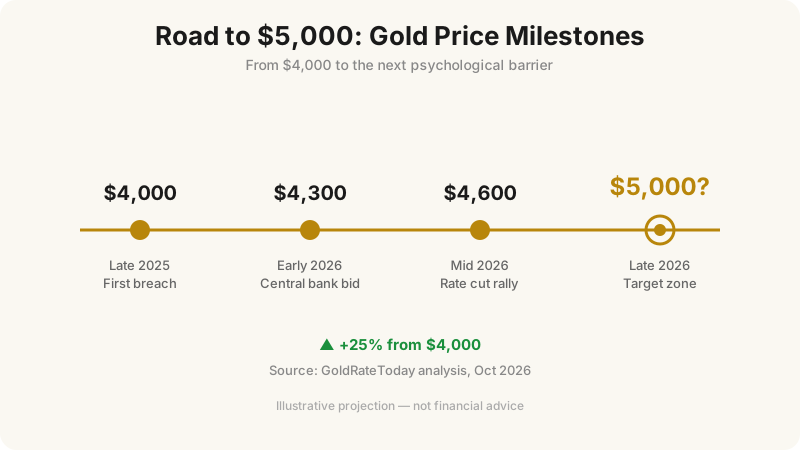
Gold is trading near $4,000 an ounce — a level that would have sounded absurd just a few years ago. The metal has climbed steadily through 2025 and 2026, powered by forces that show no sign of fading: central banks buying at a historic pace, interest rate cuts making non-yielding assets more attractive, and geopolitical tensions pushing investors toward safety. If you check the live gold price on any given morning, the trend is hard to miss.
That raises the obvious question: is $5,000 next? It would be a 25% jump from current levels — a big move, but not unprecedented for gold. The metal has delivered gains of that size in single years before, most recently during the post-2008 rally and again in 2020. The real question is not whether gold "can" move that far, but whether the conditions are in place to sustain it.
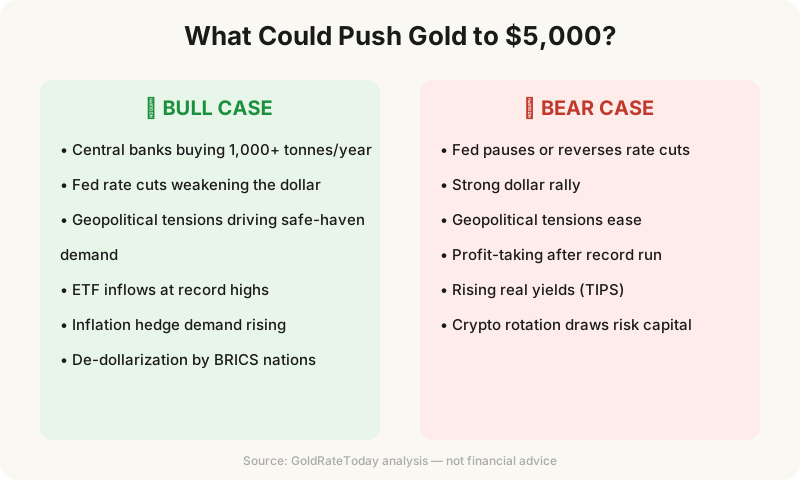
The bull case: why $5,000 is on the table
Start with central banks. They have been buying gold at the fastest pace in modern history — over 1,000 tonnes a year for several years running. This is not speculation; it is structural demand from institutions diversifying away from dollar-denominated reserves. Countries worried about sanctions, currency risk, or dollar weaponization keep adding to their vaults, and every tonne they buy tightens the physical market.
Then there is monetary policy. When the Federal Reserve cuts rates, gold tends to shine because the opportunity cost of holding a non-yielding asset falls. A weaker dollar — which usually accompanies rate cuts — makes gold cheaper for buyers in other currencies, boosting demand further. Add persistent inflation eroding cash savings, and you have a textbook setup for higher gold prices.
Geopolitics is the third pillar. Trade tensions, regional conflicts, and election uncertainty across major economies keep safe-haven demand elevated. Gold does not need a crisis to rise — it just needs enough uncertainty to make investors nervous about everything else. Right now, there is no shortage of that.
What the major banks are forecasting
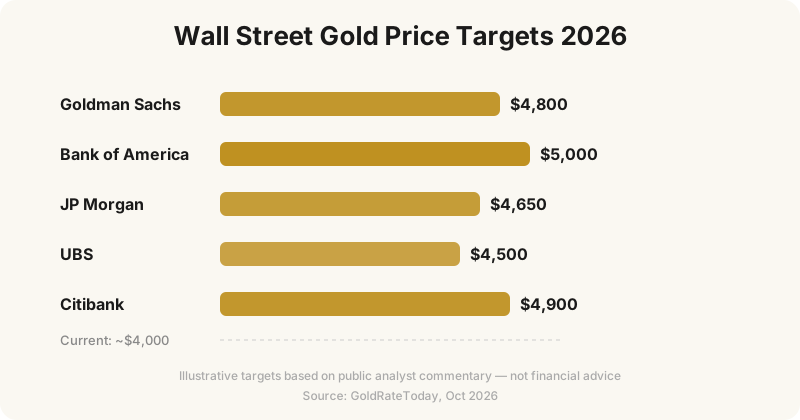
Wall Street has been revising gold targets upward all year. Goldman Sachs has pointed to continued central bank demand and ETF inflows as reasons to expect further gains, with some of the more bullish outlooks on the Street now entertaining $5,000 as a plausible scenario rather than a fantasy. Bank of America has similarly flagged the combination of rate cuts and reserve diversification as supportive for sharply higher prices.
It is worth being honest about what these forecasts are: educated guesses, not guarantees. Banks revise targets constantly, and they have been wrong about gold before — in both directions. The value in reading analyst forecasts is not the specific number but the reasoning behind it. When multiple major institutions point to the same drivers (central banks, rates, dollar), that consensus tells you something about where the smart money sees the trend going.
For historical context, pull up the gold price chart and zoom out. Every major gold rally in history looked "overextended" right before it kept going. That does not mean this time is the same — but it is a reminder that momentum in gold can persist far longer than skeptics expect.
The bear case: what could stop the rally
No honest forecast ignores the downside. The biggest risk to $5,000 gold is a hawkish surprise from the Federal Reserve. If inflation proves stickier than expected and the Fed pauses cuts — or worse, hints at hikes — the dollar would strengthen and gold would likely sell off hard. Gold pays no interest, so any environment where cash yields rise is hostile to it.
Profit-taking is another real threat. After a multi-year rally, a lot of investors are sitting on large gains. It only takes one catalyst — a strong jobs report, a de-escalation in a major conflict, a sudden dollar rally — to trigger a wave of selling. Corrections of 10-15% are normal even in strong bull markets, and they feel brutal when you are living through them.
There is also the simple math of sentiment. When everyone expects $5,000, positioning gets crowded. Markets have a habit of punishing consensus. The gold price history is full of moments where euphoria marked a top, at least temporarily. That does not mean the long-term trend is broken — but the path to $5,000 is unlikely to be a straight line.
What $5,000 gold would mean for investors
If gold does reach $5,000, the ripple effects go beyond the metal itself. Silver typically outperforms gold in strong precious-metal rallies — a rising gold price often drags silver prices up even faster in percentage terms. Mining stocks, which are leveraged plays on the gold price, could see outsized moves. And jewelry buyers would feel the pinch as retail premiums climb.
For the average person, the practical takeaway is simpler: understand why you own gold before you buy more of it. If it is insurance against chaos, a higher price just means your insurance got more expensive — the logic for holding it has not changed. If it is a trade, have an exit plan, because nothing goes up forever.
Nobody can tell you with certainty whether gold hits $5,000 in 2026. But the forces pushing it higher are real, measurable, and still in place. The balanced view: the path of least resistance looks upward, but expect volatility — and never invest money you cannot afford to see swing 15% in either direction.