Gold in pesos right now
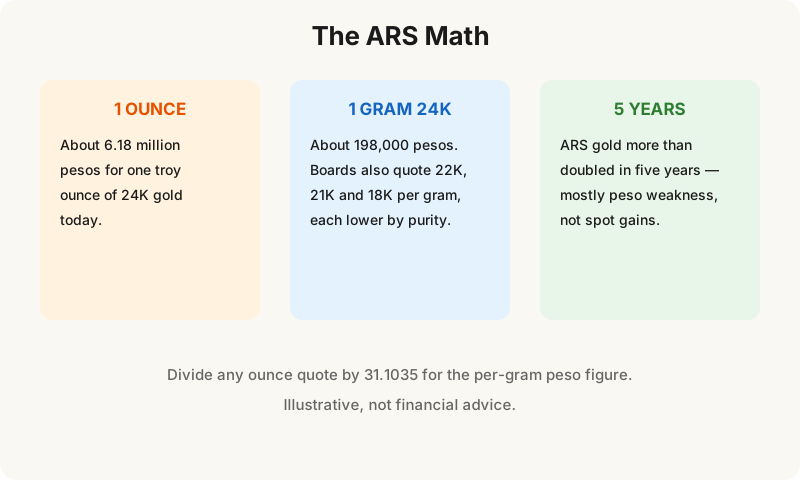
Gold in Argentina is trading at about 198,000 pesos per gram for 24K metal, or roughly 6.18 million pesos per troy ounce, up about 0.9% on the day. If you check the gold price in Argentina, those are the numbers that greet you — and they look enormous until you remember they are priced in a currency that has lost most of its value against the dollar over the past decade.
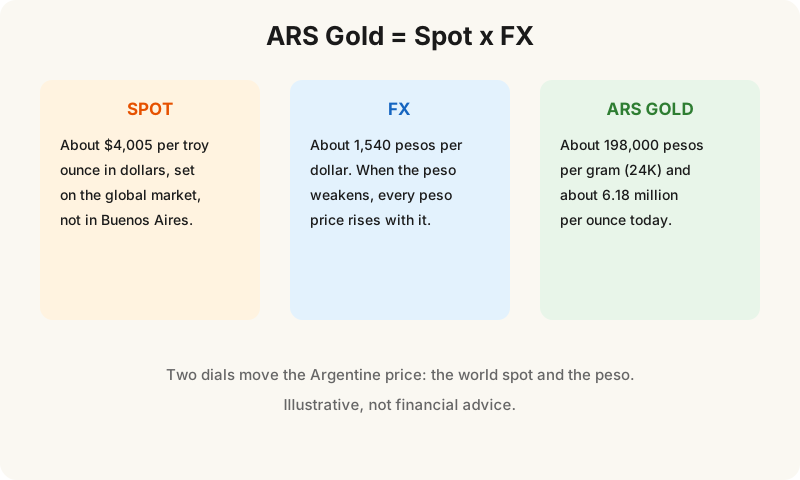
The exchange rate is the key. At roughly 1,540 pesos per dollar, the dollar price of gold — near $4,005 an ounce globally — converts into millions of pesos before anyone has added a local premium. The live gold price in dollars is therefore only half the Argentine story; the other half is the peso.
Argentine price boards quote gold by karat as well as by weight: 24K, 22K, 21K and 18K per gram, each lower than the last in proportion to its purity. A buyer comparing two quotes needs both numbers — the karat and the gram — or the comparison is meaningless.
The peso is half the price
The arithmetic is simple and it explains almost everything about Argentine gold. The peso price equals the dollar spot price multiplied by the exchange rate, divided by 31.1035 grams per ounce. Move either input and the peso price moves: a rising dollar spot lifts it, and a weakening peso lifts it just as surely, even on days when the world price is flat.
The past year proves the point in both directions. Over five years, gold in pesos more than doubled — but that was mostly the peso weakening, not the metal rising. Over the past year, gold in pesos rose only about 7.9%, because the peso was comparatively steady while the dollar spot price fell. Gold in pesos hedges peso weakness; it does not hedge every bad year, and confusing the two is the most common mistake Argentine savers make.
The per-gram math is worth knowing for exactly that reason. Divide any ounce quote by 31.1035 and you have the gram figure; multiply a gram figure by the karat's purity fraction and you have the value of lower-karat metal. Our per-gram gold price page shows the dollar side of that calculation live.
From 25.5% monthly inflation to 1.7%
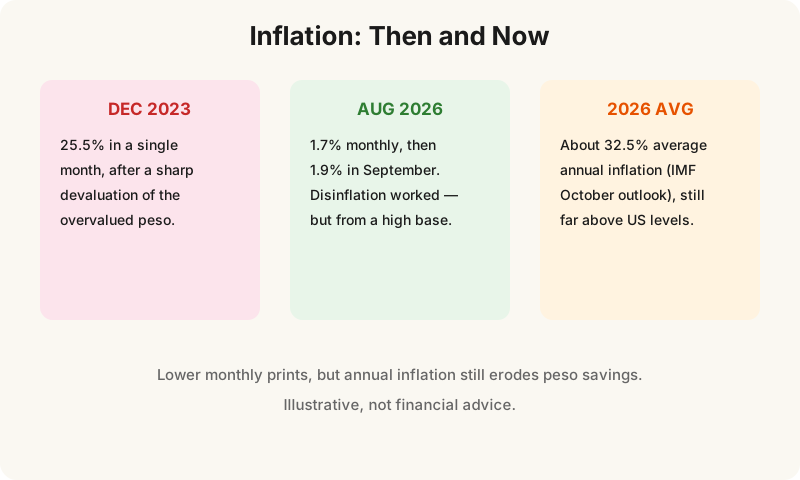
Argentina's inflation story frames the gold story. Monthly inflation hit 25.5% in December 2023, after the new government sharply devalued an overvalued peso — a move the IMF itself attributed as the main driver of that month's surge. By August 2026 the monthly rate had fallen to 1.7%, and September printed 1.9%: disinflation, by any standard, has worked.
But the annual numbers remind you why gold still matters. The IMF's October outlook puts average annual inflation at 32.5% for 2026, and BBVA Research expects year-on-year inflation near 29% by end-2026, easing toward 20% in 2027. A saver holding pesos through a year like that still loses roughly a third of their purchasing power — which is why the hedge argument survives even as monthly prints improve.
That is the honest version of the hedge case. Gold protects against peso devaluation and against the slow erosion of high annual inflation; it does not protect against a year in which the peso is steady and the world price falls, as the past twelve months showed. Our guide to what affects the gold price explains the global drivers that decide which of those years you get.
How Argentines actually hold gold
In practice, Argentine gold means grams, not ounces. Jewelry and small bars dominate, quoted per gram by karat, because few savers transact in whole ounces at 6 million pesos apiece. The 21K quote on Argentine boards surprises visitors — it is a regional convention, sitting between 22K and 18K — and it is a reminder to always check purity before comparing prices across countries.
The central bank's side of the story matters too. The BCRA has been a net buyer of dollars in early October, lifting gross reserves to roughly $49.1 billion, and the official wholesale peso has sat unusually steady near 1,520. Analysts surveyed by the central bank expect the peso to resume faster depreciation into the 2027 pre-electoral period, with year-end expectations near 1,614 to 1,630 per dollar. If that path holds, the peso leg of the gold price rises again.
Purity is the detail that protects buyers. A 24K piece is 99.9% fine gold; lower karats trade at proportionally lower gram prices, and anything unmarked should be treated with suspicion. Our gold karat and purity guide explains how to read those marks before you pay.
What to watch
Three things decide the Argentine gold price from here: the world spot price, the peso, and whether disinflation holds. A falling spot with a steady peso pushes ARS gold down; a steady spot with a weakening peso pushes it up; both moving the same way produces the big moves in either direction.
The growth backdrop is softening — the IMF cut its 2026 growth forecast to 2.1% in October, and private analysts expect less — which keeps pressure on the reform program and, by extension, on the peso. None of that is a reason to buy or sell on its own; it is context for why the exchange-rate leg of the price deserves as much attention as the metal itself.
For readers tracking Argentina, the habit is simple: check the Argentina price page for the live peso quote, and read it against both the dollar spot and the exchange rate. And keep the longer view from our gold price prediction in mind — the drivers are the same, only the currency changes the arithmetic. This is not financial advice.
It is also worth separating the two questions Argentines ask about gold. The first is whether the metal protects savings, and the answer depends on the peso: when the currency weakens, peso gold rises almost by definition. The second is whether it beats local inflation in any given year, and that answer depends on both the peso and the world price together — which is why a year like the past one, with a steady peso and a falling spot, can disappoint even while the long-run hedge case stays intact. Holding both ideas at once is the difference between using gold as insurance and expecting it to behave like a savings account.