Gold in the USA right now
Spot gold is trading near $4,005 an ounce on Tuesday, October 27, after closing Friday at $3,995.81 — the first close below $4,000 since mid-July — and touching $3,975.23 during Friday's session. If you check the live gold price on any given morning, the mood shift is plain: after months of records, sellers have the upper hand, and the US market is where that story is priced.
For American readers the number that matters most is the dollar price, because gold is priced in dollars everywhere. The gold price in the USA is therefore the world price translated into the currency Americans actually spend — around $129 per gram at current spot — before any dealer premium, making charge or local sales treatment. When spot moves, the US price moves with it, tick for tick.
This post is about the machinery behind that number: the Federal Reserve's decision cycle, the dollar, and the data calendar that moves both. None of it is a forecast you should trade on — it is a map of the forces, so the next headline makes sense when it lands.
The Fed week: decision Wednesday, PCE Thursday
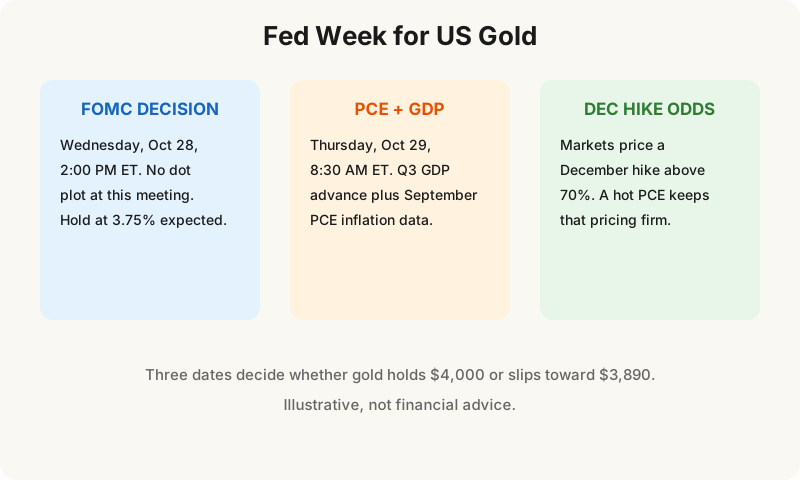
The Federal Open Market Committee meets October 27–28, with its decision due Wednesday, October 28 at 2:00 PM Eastern, followed by Chair Kevin Warsh's press conference. There is no new dot plot at this meeting, so the statement's language — and what Warsh says about December — will carry the whole message. The market's base case is a hold, with the policy rate expected to stay at 3.75%.
What makes this week unusual is what lands the next morning. Thursday, October 29 brings the advance estimate of third-quarter GDP together with September PCE inflation, the Fed's preferred inflation gauge, at 8:30 AM Eastern. A soft PCE reading would loosen the case for another hike; a hot one would tighten it — and gold, which pays no yield, feels that repricing within minutes. Traders tracking the odds use CME FedWatch, which turns futures prices into hike probabilities.
Right now those probabilities point to a December hike priced above 70%, even as an October move looks unlikely. That combination — hold now, hike later — is exactly why gold is struggling: every week the market keeps a hike on the table is another week that holding non-yielding metal costs more than holding bonds. The Federal Reserve itself publishes the meeting calendar and statements, and reading the primary source beats any headline summary.
The dollar: gold's mirror
Gold's oldest rival is the dollar, and the mechanism is mechanical. Because gold is priced in dollars, a stronger dollar makes gold more expensive for buyers in other currencies, which trims demand at the margin; a weaker dollar does the reverse. This week the dollar sits near a two-week high, which is one more weight on the metal alongside the rate story.
The second rival is real yields — the return on inflation-protected Treasuries. When real yields rise, the opportunity cost of holding gold rises with them, because bonds pay you to wait and gold does not. The 10-year Treasury yield near 5.3% is the backdrop to every gold discussion this autumn: it is hard for a non-yielding asset to rally while safe government paper pays that much. Our guide to what affects the gold price walks through both forces in depth.
The two forces often move together, but not always, and the exceptions matter. A falling dollar with rising real yields can leave gold roughly flat, while a rising dollar with falling real yields can do the same. Watching only one of them is how investors get surprised; watching both is how they stay oriented.
Why US prices differ from spot
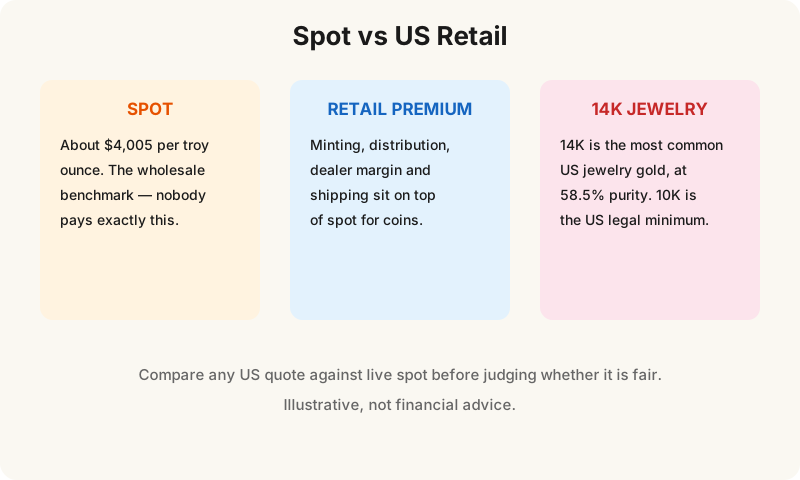
If spot is near $4,005 an ounce, why does an American buyer pay more? The gap is the premium: minting, distribution, insurance and the dealer's margin, layered on top of the wholesale price. Coins and small bars carry larger percentage premiums than large bars, because the fixed costs are spread over less metal.
Jewelry adds another layer. Most US jewelry is 14K gold, meaning 58.5% purity, and the legal minimum karat sold as gold in the United States is 10K, at 41.7%. A 14K chain's price therefore reflects not just its gold content but its craftsmanship — which is why comparing a jewelry quote to the spot price, gram for gram, will always look confusing until you separate metal value from making value.
Futures add a third reference. COMEX gold futures in New York trade alongside spot and often lead it during fast news, because paper markets react in milliseconds while physical dealers take minutes to adjust quotes. When futures and spot disagree, the gap usually closes quickly — but in the minutes between, headlines can look contradictory.
What to watch into the end of 2026
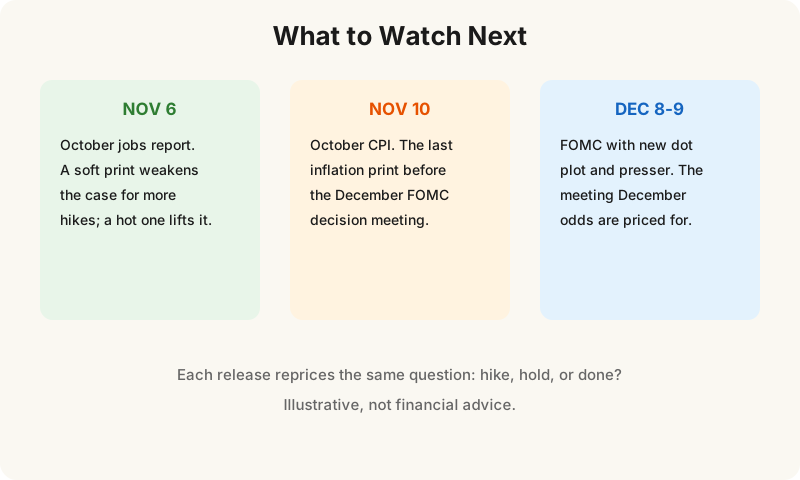
After this week, the calendar stays busy. November 6 brings the October jobs report, November 10 brings October CPI — the last inflation print before the December meeting — and December 8–9 brings the FOMC meeting with a new dot plot and press conference. Each release reprices the same question: hike, hold, or done.
The scenarios are straightforward to state. A Fed that leaves December open plus a soft PCE print would ease the pressure on gold and could carry it back toward $4,100; a December signal plus a hot PCE would keep the pressure on and open the lower levels technicians are watching, near $3,890. Neither path is a prediction — they are the two branches the market is already pricing, and the data will choose between them.
For readers following the US market, the practical habit is simple: check the gold price chart against the data calendar, not against headlines alone. And remember the longer view from our $5,000 gold outlook — the metal's big moves come from the same drivers, just on longer timescales. This is not financial advice; it is a framework for reading the next two months without being whipsawed by every print.
One more habit helps: separate the decision from the reaction. Markets often move sharply in the minutes after a Fed statement and then retrace part of the move once the press conference adds context — so the first print is rarely the final verdict. Waiting for the press conference before judging a decision's meaning is a small discipline that prevents most overreactions.