Where Bitcoin stands right now
Bitcoin is trading near $79,700, down from its earlier highs and well below the six-figure levels many holders expected to see hold. For a market used to vertical rallies, that pullback feels like a verdict. It is not. Bitcoin has fallen 50 percent or more several times in its history and recovered each time, and it has also spent long stretches going sideways while the headlines moved on. The honest starting point for any 2027 forecast is therefore not a price target but a question: has anything fundamental changed, or is this just another cycle doing what cycles do?
Check the live Bitcoin price on any given morning and the volatility is obvious. Unlike gold, which trades during market hours, Bitcoin trades around the clock, so weekend news moves the price just as fast as weekday news. That 24/7 structure is part of why drawdowns feel so violent: there is no closing bell to pause the selling, and leveraged positions get liquidated at 3 a.m. just as easily as at 3 p.m. Anyone forecasting Bitcoin without accounting for that structure is forecasting a different asset.
The pullback also has to be read against the wider market. When the live gold price is near $4,000 an ounce and investors are pricing higher-for-longer interest rates, risk assets of every kind face the same headwind. Bitcoin is not being singled out. It is behaving, for now, like a high-beta technology asset rather than the digital gold its supporters want it to be.
The bull case: why a 2027 recovery is plausible
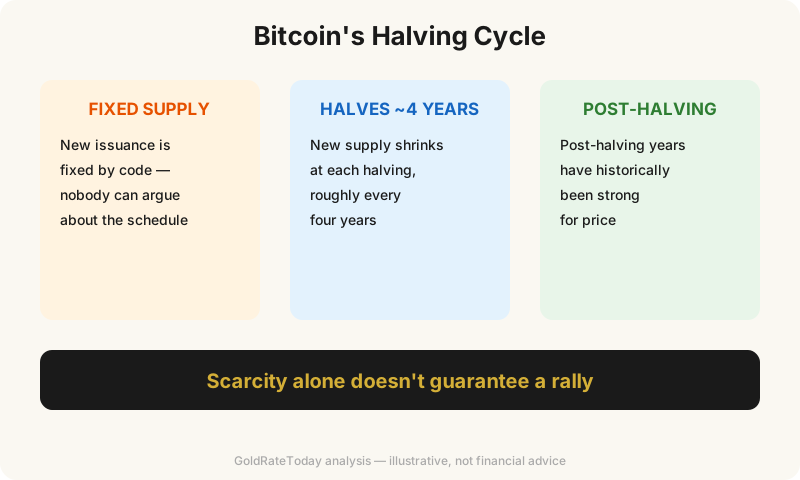
Start with supply, because Bitcoin's supply schedule is the one thing nobody can argue about. New issuance is fixed by code and halves roughly every four years, and the post-halving years have historically been strong for price. Scarcity alone does not guarantee a rally, but a shrinking new supply meeting steady or rising demand is a tailwind that gold, silver, and every other commodity would envy.
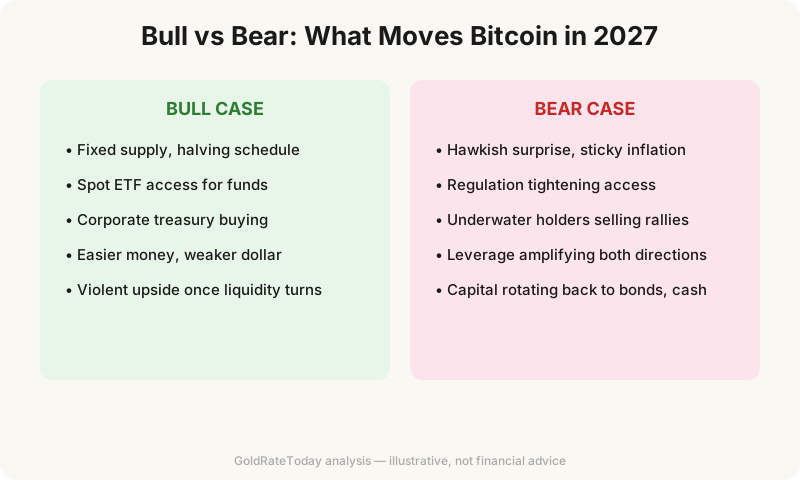
Then there is institutional demand. Spot Bitcoin ETFs gave pension funds, wealth managers, and ordinary brokerage accounts a regulated way to buy Bitcoin without managing private keys. That plumbing matters more than any single headline: once an asset is available inside the accounts people already use, flows become steadier and less dependent on crypto-native exchanges. Corporate treasuries holding Bitcoin as a reserve asset point in the same direction, even if the amounts remain small next to gold reserves.
Finally, there is the monetary backdrop. If central banks return to cutting rates and the dollar weakens, the same forces lifting gold tend to lift Bitcoin too, only faster. Bitcoin's history is a history of violent upside once liquidity turns: long flat periods followed by months in which years of gains arrive at once. A 2027 recovery does not require a new miracle. It requires the familiar combination of tight supply, easier money, and investors remembering why they wanted exposure in the first place.
The bear case: what could keep Bitcoin down
No honest forecast skips the downside, and Bitcoin's downside is larger than gold's. The biggest risk is a hawkish surprise: if inflation stays sticky and central banks keep rates high, assets that pay no yield suffer, and Bitcoin pays nothing at all. In that world, capital rotates back to bonds and cash, and Bitcoin's recovery stalls no matter how good the long-term story sounds.
Regulation is the second risk. Rules on exchanges, custody, taxation, and stablecoins differ by country and change quickly. A single major jurisdiction tightening access can drain liquidity for months, and Bitcoin has no central issuer to lobby, reassure markets, or stabilise the price. That decentralisation is a feature for its supporters and a vulnerability for its price.
There is also simple market structure. After a sharp fall, many holders are underwater and sell every rally back toward their entry price, creating resistance overhead. Add leveraged traders, who amplify moves in both directions, and you get a market that can stay choppy long after the fundamental story improves. The Bitcoin price chart shows this pattern repeatedly: recoveries that look decisive, then fail, then finally succeed on the third or fourth attempt.
What analysts are actually saying — and what it is worth
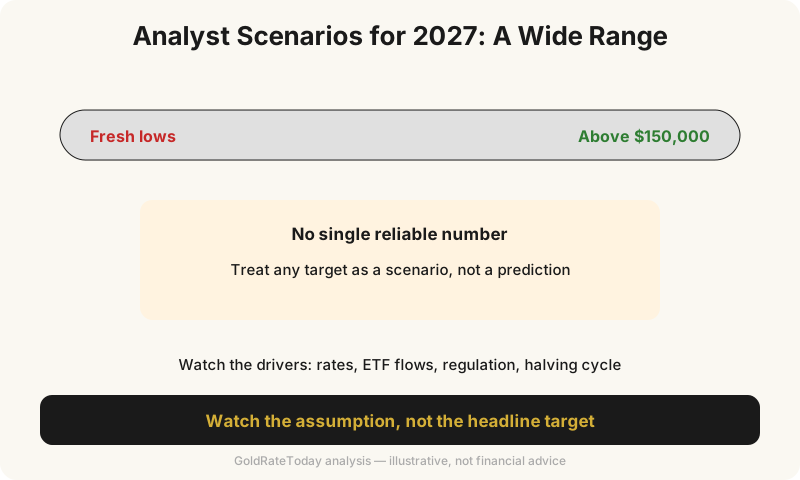
Published forecasts for Bitcoin span an absurd range, from fresh lows to new all-time highs above $150,000, and that range itself is the lesson. Analyst targets are built on different assumptions about rates, regulation, ETF flows, and the halving cycle, so two smart people can look at the same data and reach opposite conclusions. Treat any single target as a scenario, not a prediction.
The useful part of analyst commentary is the reasoning, not the number. When several independent sources point to the same drivers — ETF inflows, the supply schedule, and the rate cycle — that consensus tells you where the debate actually sits. When they disagree, the disagreement usually traces back to one assumption, most often whether the Federal Reserve cuts aggressively or not. Watch that assumption, not the headline target, and you will know sooner than most whether the forecast is breaking your way.
For context, pull up the Bitcoin price history and zoom out. Every previous cycle contains a moment when Bitcoin looked finished, followed by a period when it looked unstoppable. Neither moment was the whole story. The investors who did best were rarely the ones who called the exact bottom; they were the ones who sized their position so they could survive being wrong for months.
What a 2027 recovery would mean — and how to think about it
If Bitcoin recovers in 2027, Ethereum and the wider crypto market will almost certainly move with it, as they have in every prior cycle. Altcoins typically lag Bitcoin at first, then outperform briefly near the top of a rally, then fall hardest on the way down. That sequence is a warning as much as an opportunity: chasing the laggards late in a move has historically been the most expensive way to participate.
For gold holders, a Bitcoin recovery is not a threat to gold. The two assets have spent years being compared, but they serve different roles in most portfolios: gold is the crisis hedge with a 5,000-year record, Bitcoin is the high-volatility growth bet. A rising Bitcoin price does not require a falling gold price, and the gold price today holding near record levels while Bitcoin pulls back is itself evidence that the two markets can diverge for long stretches.
The practical takeaway is position sizing, not price guessing. Decide in advance what share of your money Bitcoin represents, what drawdown you can tolerate without panic-selling, and what would make you change your mind. Write it down. Then let the market do what markets do. Nobody can tell you with certainty whether Bitcoin recovers in 2027, but the forces that have driven every previous recovery — fixed supply, growing access, and shifting liquidity — are still in place, and they are measurable even when the price is not cooperating. This is not financial advice; it is a framework for reading the next year without being whipsawed by every headline.