Dubai's gold market at a glance
Dubai is one of the world's major gold trading centres, and its reputation rests on a simple fact: headline gold prices there sit unusually close to the world spot price. Hundreds of competing shops in the historic Gold Souk keep dealer margins thin, and the tax treatment of bullion removes a cost that other markets add — so the number on the board looks a lot like the number on the global market.
That closeness is the reason the city draws buyers from across the region and beyond. But it is also widely misunderstood: the price on the board is not the price at the till, and the gap between them depends entirely on what form the gold takes. Bars, coins and jewelry are taxed differently, and confusing them is how visitors overpay.
This post explains the machinery: how Dubai rates track the global benchmark, how VAT treats bullion differently from jewelry, what tourists can reclaim, and how Dubai compares with its neighbours. The live per-gram rates for the Emirates are on our gold price in the UAE page.
The souk and the spot price
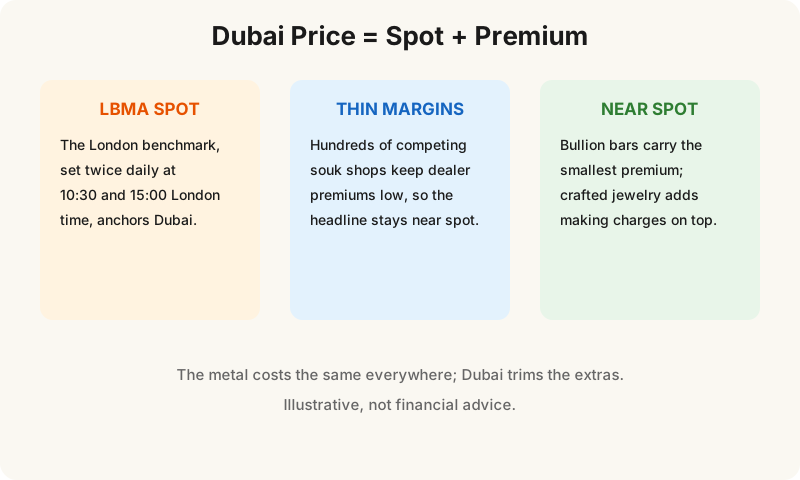
Every Dubai gold rate starts from the same place: the London benchmark. The LBMA Gold Price is set in two electronic auctions each London business day, at 10:30 AM and 3:00 PM London time, and administered independently by ICE Benchmark Administration. Dubai dealers price off that benchmark plus a premium — and competition keeps the premium small.
The souk's structure is what keeps it that way. With so many shops quoting the same metal within walking distance, any dealer charging far above the going premium loses the sale within minutes. That is why Dubai's headline rates track spot so tightly, and why the real differences between shops show up in making charges and service rather than in the metal price itself.
The benchmark matters beyond Dubai too. Miners, refiners, ETFs and central banks use the LBMA auctions as a reference for valuing holdings and settling contracts, which is why the twice-daily auction price — rather than any single dealer's quote — is the number the whole industry can agree on. Our guide to how the gold price is determined explains the auction in full.
VAT: the two golds
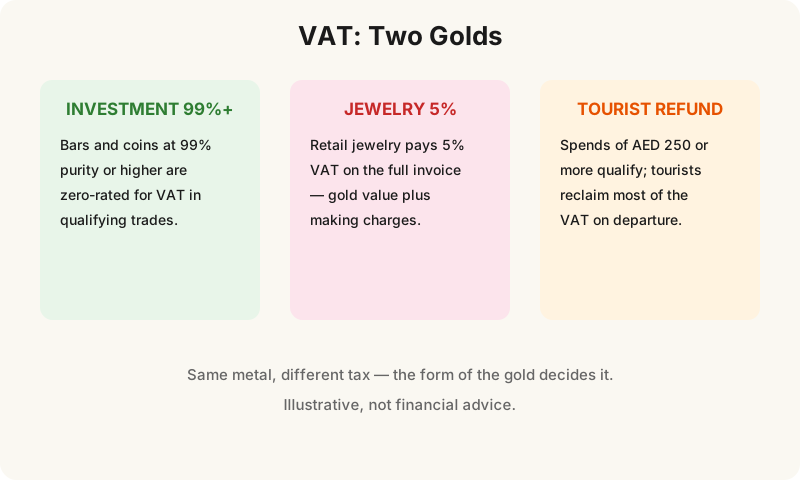
The single most important tax fact in Dubai is that there are effectively two golds. Investment-grade gold — bars and coins at 99% purity or higher, traded in qualifying transactions — is zero-rated for VAT under Cabinet Decision 52 of 2017, meaning no VAT applies. Retail jewelry, by contrast, pays the standard 5% VAT.
The jewelry calculation catches people out because VAT applies to the full invoice, not just the metal. A necklace priced at 10,000 dirhams — 8,500 for gold and 1,500 for making charges — carries 500 dirhams of VAT at the till, because the making charge is part of the taxable amount. Two purchases with the same gold content can therefore carry very different tax bills.
The boundary between the two categories is purity and form, and it is enforced: a bar that fails the purity test, or a coin marketed as jewelry rather than bullion, can be reclassified into the standard-rated category. If a deal looks too good to be true, the classification is usually the reason.
Tourists, duties and the India comparison
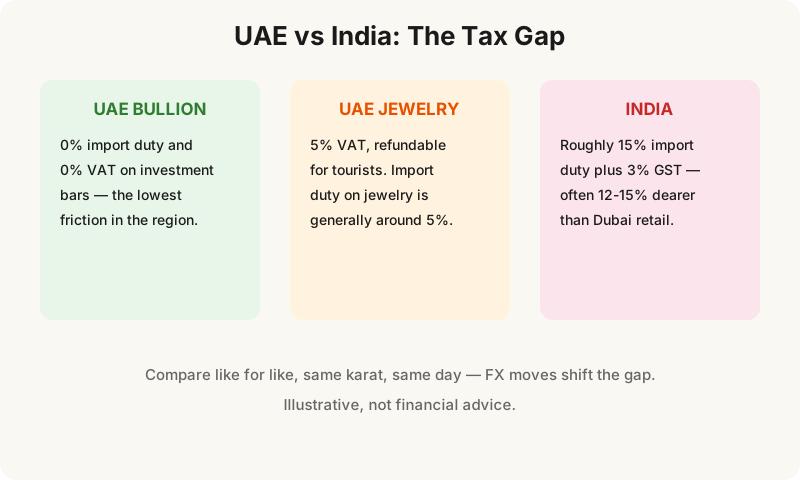
Tourists get one more advantage: jewelry purchases of at least 250 dirhams from a participating retailer qualify for a VAT refund on departure, returning most of the VAT after administrative fees. Residents cannot reclaim it, which is one reason the same piece can feel cheaper to a visitor than to a local.
Import duty sharpens the gap further. Investment gold enters the UAE duty-free, and duty on jewelry is generally around 5%. Compare India, where gold carries roughly 15% import duty plus 3% GST — often making the same purity 12 to 15% dearer than Dubai retail — and the city's reputation starts to look like arithmetic rather than marketing. Our gold price in India page shows the other side of that comparison live.
One warning belongs here: carrying gold home means facing your own country's customs allowance and duties, which can erase the Dubai saving if ignored. The comparison that matters is the landed cost at home, not the till price in the souk.
Reading a Dubai gold rate
A Dubai quote has four layers, and separating them is the whole skill: the spot benchmark, the dealer premium, the making charge (jewelry only), and VAT (jewelry only, refundable for tourists). Bullion bars skip the last two layers almost entirely, which is why their till price sits closest to spot.
Purity is the other half of reading the board. Investment bars are 24K, or 999.9 fine; most jewelry is 22K, about 91.6% gold, alloyed for durability. A 22K gram will always cost less than a 24K gram, and comparing them without adjusting for purity is the most common beginner error. Our karat and purity guide covers the conversions.
The habit for anyone following Dubai is simple: check the gold price chart for the world move, then the UAE page for the local rate, and judge any shop quote against those two numbers — not against another shop's headline. This is not financial advice; it is how to read a market that rewards the informed and charges the hurried.
Two final checks separate a good Dubai quote from a poor one. The first is the karat stamp: reputable shops state purity plainly, and any piece without a clear mark deserves skepticism no matter how attractive the price looks. The second is the invoice breakdown: a trustworthy seller shows the metal value, the making charge and the VAT as separate lines, so you can see exactly what you are paying for and, as a tourist, what you can reclaim. Shops that bundle everything into a single opaque figure make comparison impossible by design. A third habit costs nothing: check the live UAE rate and the world spot before you walk in, so you already know the fair range for the gram you are buying. With those three numbers in hand — spot, local rate and the shop's breakdown — the souk's famous competition works in your favour, because every dealer knows you can walk a few steps to the next counter.