Gold slips below $4,000: what just happened
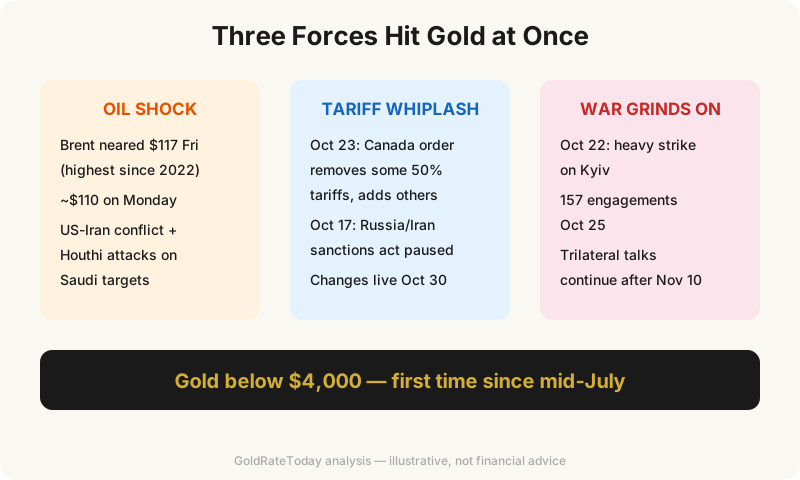
Spot gold is trading around $3,987 to $4,010 an ounce on Monday, October 26 - below $4,000 for the first time since mid-July and near a three-month low. The metal fell about 4% last week, its steepest weekly decline in more than four months, since June. If you check the live gold price on any given morning, the change in mood is obvious: after months of records, sellers are suddenly in control.
Silver is feeling it too. Silver is trading near $54 an ounce, close to an 11-month low, and on India's MCX silver fell 7.14% last week. MCX gold futures, meanwhile, were around Rs 1,42,809 per 10 grams on Monday, up 0.55%, while MCX silver was near Rs 1,96,650 per kg - a reminder that local prices in rupees do not always mirror the dollar move. For the gold price per ounce in dollars, though, the story is clear: the uptrend has stalled.
Technicians are watching tight levels. Per FXEmpire, resistance sits at $4,032 and then $4,075, while support lies at $3,946 and then $3,890. A hold above $4,032 would ease the pressure; a break below $3,946 would open the door to $3,890. But levels only describe the battlefield - they do not explain why gold is falling. For that, three stories collided in the same week.
The oil shock: Middle East tensions feed inflation fears
The first force is oil. Brent crude neared $117 a barrel on Friday, its highest since 2022, before easing to around $110 on Monday. The US-Iran conflict and Houthi attacks on Saudi targets are keeping energy markets on edge, according to the NordFX market pulse on October 26. When oil spikes, it does not stay in the energy market - it feeds straight into inflation expectations.
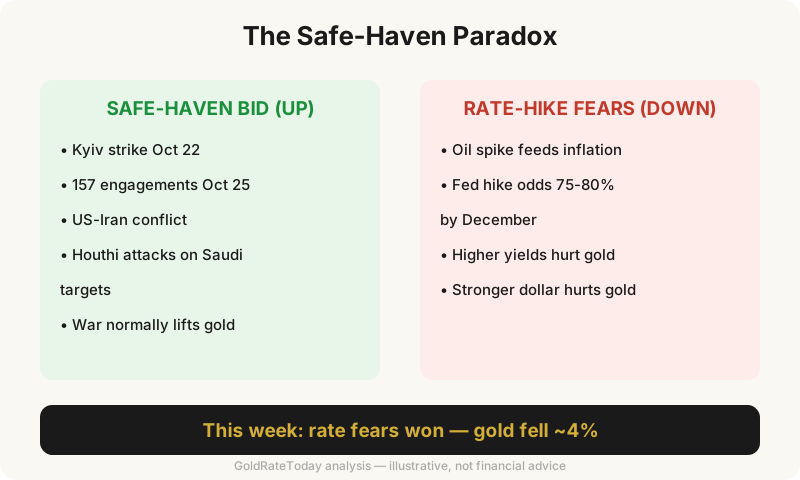
That is the channel that hurts gold. Higher expected inflation pushes markets to price in a more hawkish Federal Reserve, which lifts bond yields and the dollar. Gold pays no interest, so when yields rise, holding gold costs more in forgone income - and a stronger dollar makes gold pricier for buyers in other currencies. In other words, an oil shock can be bad for gold even though it sounds like the kind of crisis that should help it.
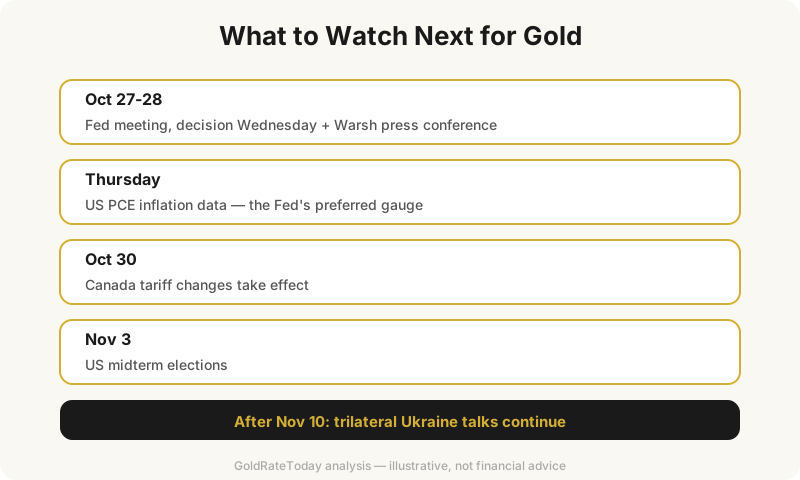
This is the week that logic played out in full. The Fed meets October 27-28, with a decision due Wednesday and Chair Kevin Warsh holding a press conference; US PCE inflation data follows on Thursday. CME FedWatch now shows roughly a 75-80% chance of at least one Fed hike by December, even though expectations of a hike at the October meeting itself have receded. Traders are not waiting for the Fed to act - they are selling gold on the fear that it might.
Trump's tariff whiplash
The second force is tariffs - and the whiplash is the point. On October 23, President Trump signed an order removing 50% tariffs on some Canadian agricultural and forestry products, including plywood sheets, paper products, certain machinery, refrigeration equipment, packing crates and boxes, and fresh and dried seaweed. The changes take effect October 30, four days before the November 3 US midterm elections, and the move was aimed at helping Senator Susan Collins of Maine, who faces a tight reelection race.
The same order, however, ADDED other Canadian products to the 50% tariff list - carpets, paints, shampoos, cocoa powder, wooden coffins, ice cream sticks, air-conditioning machines, chest freezers, archery equipment, and canoes. Relief for some exporters, a new blow for others, all in one signature. Canada, already in a technical recession after two consecutive quarters of contraction, sends roughly 70% of its exports to the US, so every tariff twist lands hard.
A week earlier, on October 17, Trump signed an executive order pausing the Lindsey Graham Sanctioning Russia and Iran Act, which would have allowed tariffs of up to 100% on countries including India and China that keep buying Russian oil. The pause followed a diesel-supply agreement with Putin, under which Russia will initially provide more than 300,000 tonnes of diesel, with further shipments in November and after. India imports about 45% of its crude oil from Russia - 2.08 million barrels per day in August - so the pause matters far beyond Washington. Pull up the gold price history and the lesson is clear: tariff shocks used to lift gold on their own, but this week the uncertainty is feeding rate-hike fears instead of safe-haven buying.
The Ukraine war grinds on - and the safe-haven paradox
The third force is the war in Ukraine, which is grinding on even as diplomacy flickers. On October 22, a heavy Russian strike hit Kyiv - hundreds of drones and at least 21 ballistic missiles, some carrying cluster munitions - killing 2 people and injuring 34, including 5 children. The strike came hours after agreement on peace talks.
The fighting has not paused. On October 25, Ukraine reported 157 combat engagements, and its General Staff claims total Russian personnel losses of about 1,580,440 since February 24, 2022, including 1,990 over the past day. On October 24, a Russian drone struck civilian infrastructure in Synelnykove in the Dnipropetrovsk region, killing 4 and injuring more than 13 near a hospital supported by Medecins Sans Frontieres. And on October 23, Melania Trump brokered a humanitarian pause around occupied Oleshky, where about 1,700 people remain of a pre-war population of roughly 24,000 - though the start date is unclear, with Russia's General Gerasimov saying October 27 and the First Lady saying October 29.
Yet there is a diplomatic thread. Putin has agreed 'in principle' to trilateral US-Ukraine-Russia talks, to continue after November 10 at technical level, with Putin not attending personally. US envoy Steve Witkoff has met Zelensky in Oslo and Putin in St. Petersburg, and Trump has said negotiators are 'maybe now the closest we've been' to ending the war.
Here is the paradox honest gold watchers must face: war tensions normally lift gold, because investors buy safety. This week they did not - or rather, the safe-haven bid was real but smaller than the selling driven by rate-hike fears. Silver is telling the same story - the silver price today shows the metal near its own 11-month low. When the fear of higher rates outweighs the fear of war, gold falls even as missiles fly. That is exactly what happened, and it is why this week's drop is about the collision of forces, not any single headline.
What to watch next
The week ahead is packed with catalysts. The Fed decides Wednesday after its October 27-28 meeting, with Chair Kevin Warsh's press conference to follow, and Thursday brings US PCE inflation data - the Fed's preferred inflation gauge. If PCE comes in hot, hike odds rise further and gold faces more pressure; if it cools, some of this week's selling could unwind.
Then come the political dates. The October 30 tariff changes take effect, days before the November 3 midterm elections, and any fresh tariff surprise could swing sentiment again. After November 10, the trilateral Ukraine talks continue at technical level - progress there would likely fade the safe-haven bid further, while a collapse would bring it roaring back.
The honest framing is scenarios, not predictions. Above $4,032, the pressure eases; below $3,946, the next stop traders watch is $3,890. The gold price chart will show which way the break goes first, and the gold price today page will carry the latest levels as they move. This post is not financial advice - it is a map of the forces and the dates that will decide gold's next move. Watch the data, not the noise, and remember that gold's biggest moves often come when several stories collide at once - exactly like this week.